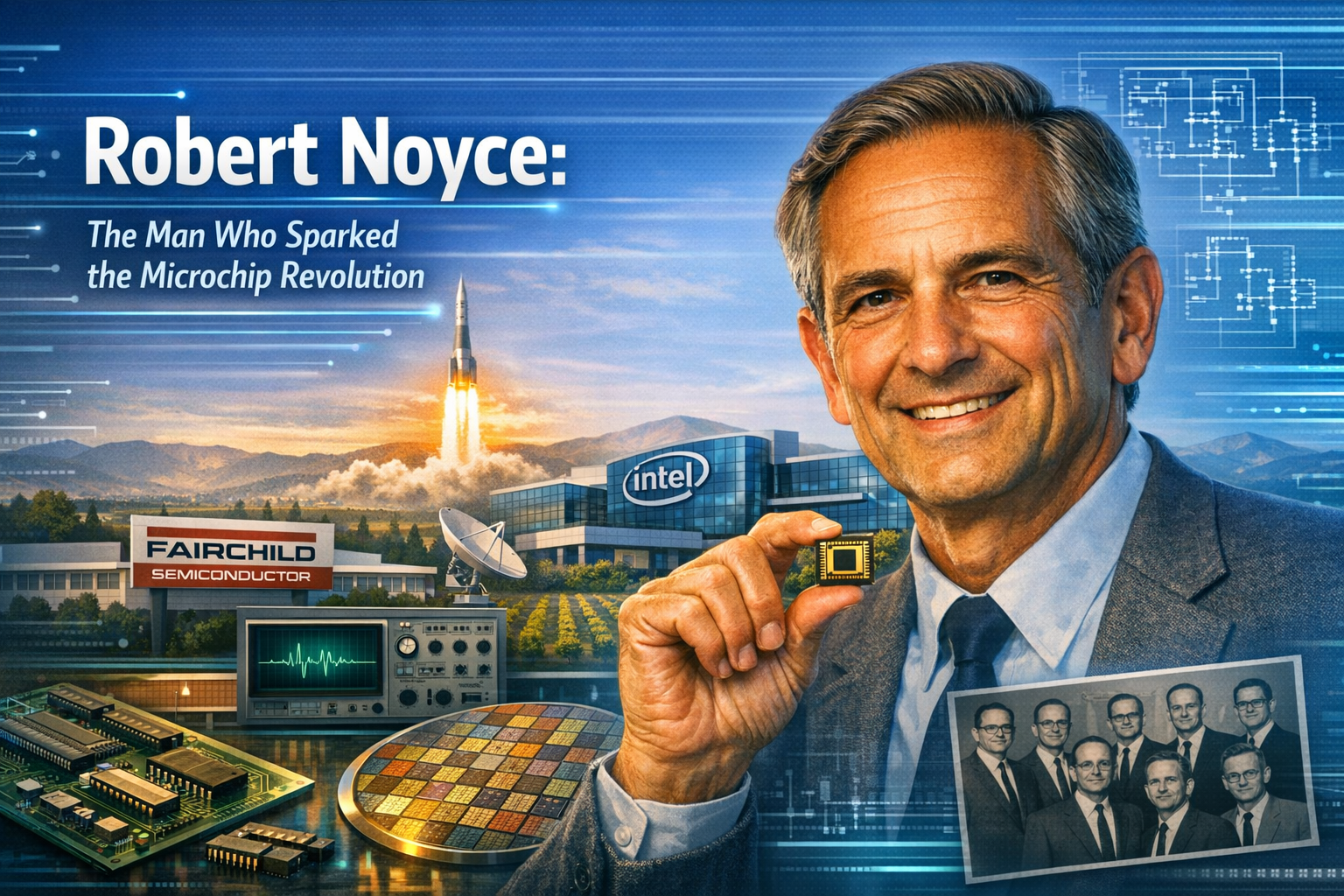
Robert Noyce: The Man Who Sparked the Microchip Revolution
Silicon Valley has no shortage of legends, but few shaped the modern world as profoundly as Robert Noyce — the charismatic engineer whose inventions and leadership helped launch the digital age. If Silicon Valley had a founding myth, Noyce would be at its center.
He wasn’t just an inventor. He was the embodiment of the Valley’s emerging culture: collaborative, optimistic, egalitarian, and relentlessly focused on building the future.
🌱 A Midwestern Mindset Meets California Possibility
Born in Iowa, Noyce carried with him a mix of small‑town pragmatism and boundless curiosity. When he arrived in California in the 1950s, the Santa Clara Valley was still “a landscape of apricot and plum orchards stretching from San Jose to Palo Alto” — a detail echoed in your January article about the Valley of Heart’s Delight.
But change was coming fast.
⚡ Fairchild Semiconductor and the Birth of the Microchip
In 1957, Noyce and seven colleagues — the now‑famous Traitorous Eight — left Shockley Semiconductor to found Fairchild Semiconductor. As your January article notes, this moment “was the birth of a new model of innovation: small teams, fast iteration, shared equity.”
At Fairchild, Noyce co‑invented the integrated circuit, the breakthrough that made modern computing possible. His version of the microchip was elegant, manufacturable, and scalable — the perfect foundation for an industry that would soon explode.
🧠 The Intel Era: A New Kind of Company
In 1968, Noyce co‑founded Intel with Gordon Moore. Their vision wasn’t just technological; it was cultural. Intel pioneered:
- flat hierarchies
- open communication
- stock options for employees
- a culture of speed and experimentation
This was the DNA of Silicon Valley.
🌐 The Legacy of a Builder
Noyce’s influence extends far beyond the microchip. He shaped the Valley’s ethos — the belief that innovation is a team sport, a theme echoed in January’s article: “Innovation here has always been collaborative… a dense web of relationships.”
Noyce didn’t just build chips. He built the culture that built the future.