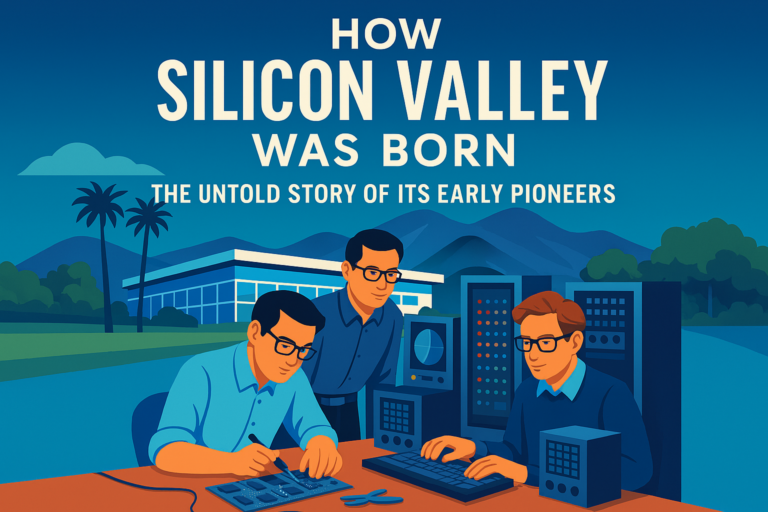
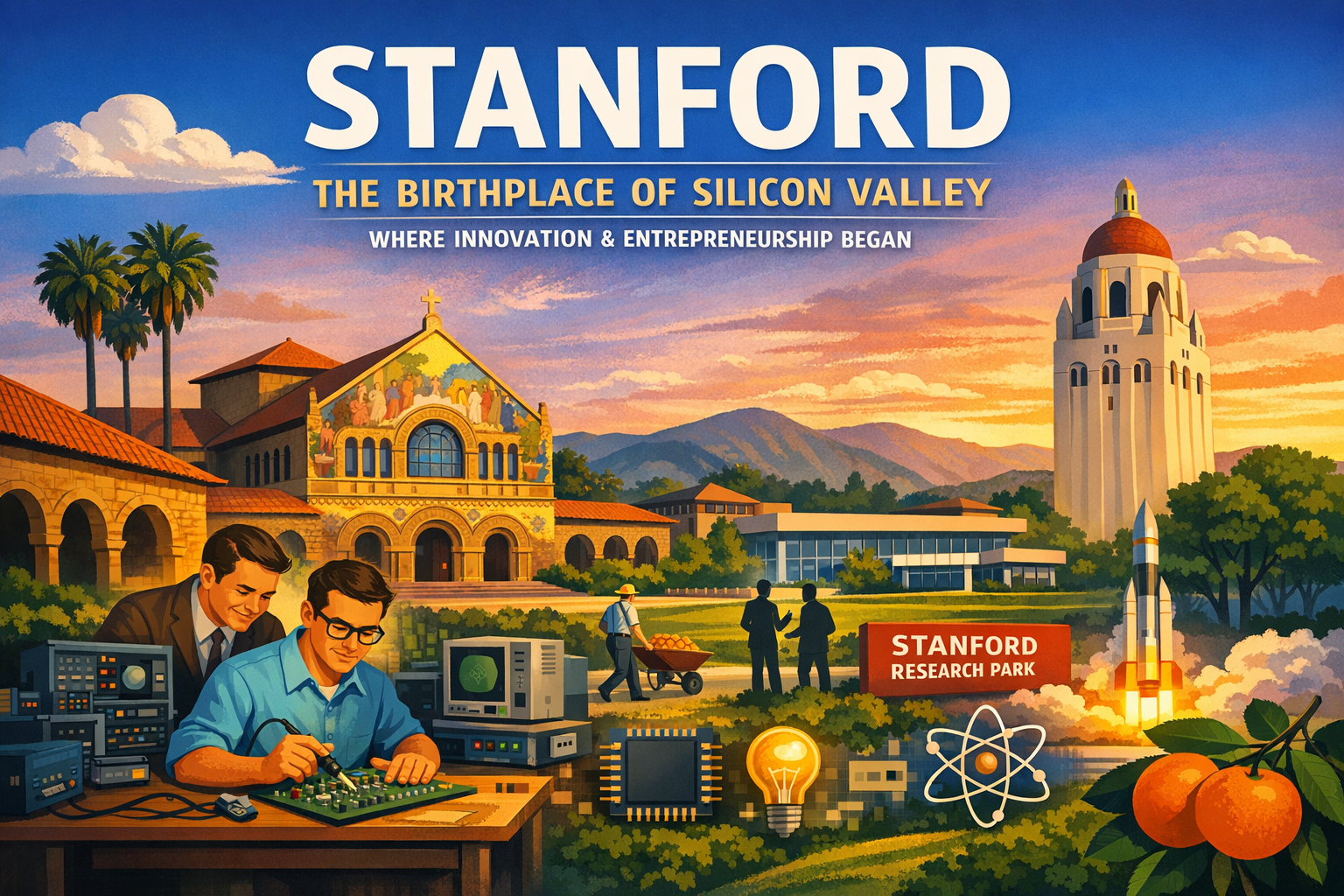
Why Stanford became the engine of global innovation
When people talk about Silicon Valley, they often focus on the companies — Apple, Google, Intel, Nvidia. But long before the world’s most influential tech giants emerged, one institution quietly laid the foundation for the entire ecosystem: Stanford University.
Stanford didn’t just educate the Valley’s pioneers. It shaped the culture, the networks, and the mindset that turned a quiet agricultural region into the global capital of innovation. Understanding why Stanford became this engine of transformation reveals how geography, leadership, and vision converged to create something unprecedented.
🎓 A University Built With a Mission
From its founding in 1885, Stanford was different. Leland and Jane Stanford didn’t want a traditional East Coast–style university. They wanted a place that would serve the future of California — a state defined by opportunity, experimentation, and reinvention.
This mission set the stage for everything that followed.
🧠 Frederick Terman: The Architect of Silicon Valley
No single person shaped Stanford’s role in innovation more than Frederick Terman, often called the “Father of Silicon Valley.”
Terman believed that:
- universities should collaborate with industry
- students should start companies
- research should solve real-world problems
- failure was part of learning
This was radical in the 1930s and 1940s, when academia was expected to stay in its ivory tower. Terman broke that model.
He encouraged two of his students — Bill Hewlett and Dave Packard — to start a company in a Palo Alto garage. He helped them secure funding. He mentored them. And in doing so, he planted the seed of what would become Silicon Valley’s first great success story.
🏭 Stanford Research Park: A New Model for Innovation
In 1951, Stanford created something no other university had attempted: a research park where companies could lease land, collaborate with faculty, and tap into student talent.
This became the birthplace of:
- Hewlett‑Packard
- Varian Associates
- Lockheed Missiles & Space
- Dozens of early semiconductor and electronics firms
It was a self‑reinforcing loop:
- Companies came for the talent
- Talent came for the companies
- Research flowed between labs and industry
- Innovation accelerated
This model has since been copied worldwide — but never replicated at the same scale.
⚡ A Culture That Encouraged Risk
Stanford didn’t just teach engineering. It taught a mindset.
Students were encouraged to:
- experiment
- collaborate
- question authority
- build things
- take risks
This culture aligned perfectly with the emerging counterculture of the 1960s and 1970s, when young engineers wanted to build tools for individuals, not institutions. Stanford became the bridge between academic rigor and creative rebellion.
🌐 A Magnet for Global Talent
By the 1980s and 1990s, Stanford had become one of the world’s most powerful magnets for ambitious students. Many of them stayed in the Valley, founding companies that reshaped the world:
- Google (Larry Page & Sergey Brin)
- Yahoo (Jerry Yang & David Filo)
- Cisco (Sandy Lerner & Len Bosack)
- Sun Microsystems (founded by Stanford students and faculty)
The pattern was unmistakable: Stanford wasn’t just producing graduates — it was producing founders.
💡 Why Stanford Succeeded Where Others Didn’t
Many universities have brilliant faculty and strong engineering programs. But Stanford had a unique combination of factors:
- Proximity to industry
- A culture of entrepreneurship
- Flexible, interdisciplinary research
- Supportive leadership
- A region open to experimentation
- A network effect that grew exponentially
Stanford didn’t just participate in Silicon Valley. It created it.
🚀 The Legacy: A University That Thinks Like a Startup
Today, Stanford remains at the center of global innovation:
- AI research
- biotechnology
- sustainability
- quantum computing
- entrepreneurship programs
- venture capital partnerships
Its influence extends far beyond California. The “Stanford model” has shaped innovation hubs from Tel Aviv to Shenzhen.
But the original remains unmatched — because it wasn’t built from a blueprint. It grew organically from a unique mix of vision, geography, and people who believed the future could be invented.
🌟 Why This Story Matters
Understanding Stanford’s role helps explain why Silicon Valley became what it is — and why innovation thrives where culture, talent, and opportunity intersect.
The Valley didn’t happen by accident. It happened because one university dared to think differently.